

Table of Contents
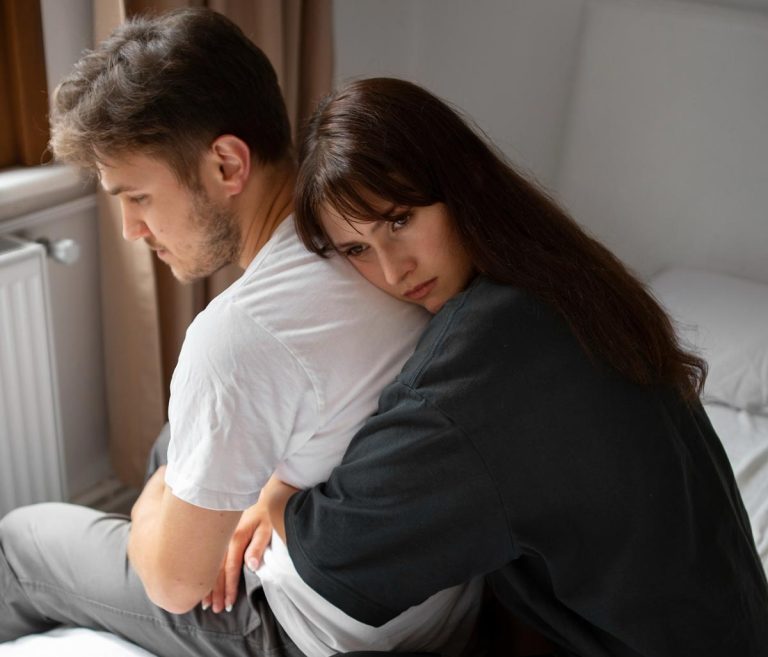
When a person goes through depression, they are not the only one who suffers. The relationship also changes. The dynamics, communication, intimacy, future plans, and even the way of living together on a day-to-day basis all shift. And although attention is often, understandably, focused on the person who is depressed, there is another reality that also needs space: that of the partner who is supporting them.
From my clinical experience, one of the phrases I hear most often in therapy is: “I know they are having a hard time, but I’m exhausted too, and I feel guilty for thinking about myself.” And that guilt often leads many people to spend months or even years enduring emotionally very difficult situations without asking for help.
Supporting someone with depression can be deeply draining. And recognizing that does not make you selfish — it makes you human.
What can we expect when a partner is depressed
Depression does not always show up as visible sadness. Sometimes it appears as irritability, emotional disconnection, apathy, or distance.

Many behaviors that cause pain within a relationship are not necessarily intended to hurt, although that does not mean they do not hurt.
The situations I describe below are some of the most common when depression affects a couple’s life. They do not always all appear, nor are they experienced with the same intensity, but they can help put words to experiences that many people describe in therapy: feeling mistreated, rejected, pushed aside, confused, or emotionally exhausted while trying to support a depressed partner.
“They treat me badly”
Many people describe their depressed partner as being more irritable, colder, or more critical. They may respond harshly, have less patience, or react with hostility to everyday situations.
This happens because depression directly affects emotional regulation. The person often feels overwhelmed, mentally exhausted, and has very little capacity to manage stress. Sometimes, frustration or inner distress ends up being directed toward the people closest to them.
However, understanding the origin does not mean justifying everything.
From my experience, it is important to make a very clear distinction here: one thing is understanding that depression can influence certain behaviors, and something very different is normalizing disrespect, humiliation, or harmful dynamics that continue over time.
“They don’t want to have sex”
A reduced sexual desire is one of the most common symptoms of depression. Energy levels drop, the body seems to “shut down,” pleasure decreases, and emotional disconnection from oneself and from the other person often appears.
In addition, some antidepressant medications can also affect desire, arousal, or the ability to enjoy sex.
Sometimes people ask me in therapy: “How do I know if they no longer desire me or if it’s the depression?” The reality is that it is not always easy to tell the difference, and that is precisely why it is important not to jump to conclusions driven by fear or insecurity.
Many couples begin to interpret the lack of sexual intimacy as personal rejection: “They’re no longer attracted to me,” “there must be someone else,” “our relationship is broken”…
And although in some cases there may be additional relationship problems, in others we are simply seeing the direct impact of a depressive disorder on sexuality.
Here, it often helps to stop viewing sex only in terms of performance or frequency and instead begin rebuilding broader spaces of intimacy: affection, physical closeness, conversation, tenderness, or small moments of connection.
“They left me”
In some cases, the depressed person unexpectedly ends the relationship or starts saying things like: “You deserve better,” “you would be better off without me,” “I don’t feel anything anymore,” or “I can’t handle this.”
Depression can create an extremely negative view of oneself, the future, and also the relationship. Many people isolate themselves because they feel like a burden or because they genuinely believe they cannot sustain an emotional bond.
From my professional experience, these breakups do not always reflect a clear relationship decision, but rather the emotional state the person is in. However, this also does not mean that the partner has to wait indefinitely or suppress their own needs.
Every situation needs to be approached individually and with great emotional care.
“They pull away from me, they isolate themselves”
Isolation is probably one of the most common symptoms of depression. The person stops going out, avoids plans, withdraws into themselves, and seems emotionally disconnected.
The partner on the other side often experiences this with a great deal of anguish: “Did I do something wrong?”, “why won’t they talk to me?”, “how can I help if they won’t let me get close?”…
And here a very painful paradox appears: the more you try to get closer, the more they seem to pull away.
Depression often leads people to avoid contact because socializing, talking, or even replying to messages can feel like an enormous mental effort. That does not mean they do not love you. But it is also important to remember that understanding the isolation does not erase the emotional impact it has on the partner.
How do you know if your partner is depressed?
It is not always easy to detect, especially when depression appears gradually. Some common signs are:
- Persistent sadness or a feeling of emptiness
- Constant irritability
- Social withdrawal
- Loss of interest in activities they used to enjoy
- Changes in sleep or appetite
- Ongoing fatigue
- Lack of motivation
- Difficulty concentrating
- Very negative comments about themselves
- Emotional or affective disconnection
- Reduced sexual desire
In therapy, many couples explain that at first they thought they were simply going through a rough patch, work stress, or exhaustion. And sometimes that may indeed be the case. But when these symptoms persist over time and clearly interfere with daily life, it is important to consider the possibility of a depressive disorder, It is important to distinguish between sadness and depression.
Is your partner’s depression affecting you?
In most cases, the answer is yes. And recognizing this is important. Many people take on the role of “the healthy one” in the relationship and begin functioning solely from a caregiving position:
- They provide emotional support
- Organize everything
- Try to understand
- Justify behaviors
- Accompany
- Try to “save” the other person
But little by little, they stop asking themselves how they are doing.
From my experience, some people arrive in therapy completely exhausted and still minimize their own suffering because they feel they “have no right” to complain. There is often a great deal of guilt about getting angry, feeling tired, needing space, missing the relationship as it used to be, or even wondering whether they can continue like this. And that guilt can lead to enormous self-pressure.
Here, we can also sometimes see what is known as Caregiver Syndrome, which frequently appears in medical illnesses: the person prioritizes the other’s wellbeing so much that they completely neglect their own.
In these situations, it is common to observe:
- Anxiety: constantly monitoring your partner’s emotional state can create a permanent sense of alertness, as if you can never fully relax and something bad might happen at any moment.
- Insomnia: many people explain that they struggle to mentally disconnect at night, whether due to worry, overthinking the situation, or staying focused on how the other person is doing.
- Emotional exhaustion: sustaining a relationship marked by suffering for a long time can lead to psychological burnout, feelings of emptiness, and the impression of having no resources left to keep going.
- Hypervigilance: it is common to constantly observe mood changes, silences, messages, or behaviors in order to anticipate how the partner feels or avoid conflict.
- A constant sense of responsibility: some people end up feeling that their partner’s emotional wellbeing depends entirely on them, carrying a burden that is impossible to sustain in the long term.
- Social isolation: little by little, friendships, leisure, or personal spaces are often abandoned because all energy becomes focused on caring, supporting, or simply “being available.”
- And even depressive symptoms: when the situation continues over time, it is not uncommon for the supporting partner to also begin feeling emotionally numb, drained, disconnected, or trapped in hopelessness.
At this point, it is very important to remember that caring for someone should not mean disappearing yourself. Setting boundaries or seeking help does not mean abandoning the other person or giving up.
What if your partner has depression and does not want to go to therapy?

This is one of the situations that generates the most feelings of helplessness, because often the person supporting their partner feels they are making huge efforts while the other person rejects any kind of help. Some guidelines that usually help are:
Avoid becoming your partner’s therapist
It is natural to want to help, but fully taking on this role often ends up being extremely draining for the relationship. Your role is to support, not to take responsibility for the other person’s recovery.
Speak from concern, not from reproach
It is usually not helpful to say:
- “You have to go to therapy”
- “This is no way to live”
- “You are hurting everyone”
Instead, it tends to work better to communicate from emotional impact and concern:
- “I can see that you are suffering”
- “I’m worried about how you are doing”
- “You don’t have to go through this alone”
Offer concrete help
Sometimes the person doesn’t even know where to start. You can offer practical support:
- Looking for professionals
- Accompanying them to the first session
- Booking an appointment
- Or simply talking about their fears regarding therapy
Understand that asking for help is also difficult
Many people feel shame, fear, emotional blockage, or even hopelessness. Depression itself can make someone believe that nothing will help.
Don’t forget to seek help for yourself as well
This is essential. Whether your partner decides to start therapy or not, you can still have a space where you can process everything you are going through. This kind of psychological support often helps you manage the situation better and make clearer, healthier decisions.
When there is love, but no tools
Loving someone deeply does not always prevent suffering. And supporting someone with depression can test even very strong relationships.
Asking for help does not mean the relationship has failed. It means something important is happening, and you do not have to manage it alone.
At the Instituto Psicología-Sexología Mallorca, one of our areas of expertise is the treatment of depression and the support of partners who are affected by it, as these goals fall within the field of general health psychology. We also incorporate our expertise in couples therapy to help both people experiencing depression and their partners understand what is happening, improve communication, rebuild intimacy, and reduce the emotional strain that often arises in these situations.
Because caring for the person affected also means caring for the one who is holding everything together.

About the author
Paola Obrador Pellicer
General Health Psychologist and sexologist · Registered B-1815
Paola Obrador Pellicer is a general health psychologist, sexologist and director of Instituto Psicología-Sexología Mallorca. She specialises in sex therapy, couples therapy, psychotrauma, EMDR and psycho-oncology.