

English banner

Love bombing: a narcissistic manipulation

Love bombing

Laura began a relationship with Raul, a really nice guy who went out of his way for her since the very beginning. He was very detailed, gave her many gifts, entertained her with the most tender and romantic words that Laura had ever heard, they talked all the time and they had a lot in common. Although it seemed a bit exaggerated and fast, she thought that maybe Raul was a very passionate guy and it was not unusual that at the beginning of the relationship that intensified.

Soon after, they had a disagreement about what they were going to do for the weekend, since Laura had two commitments with her friends and they were not going to be able to see each other. Raul got upset and ignored Laura for days. There were no more constant messages about how much he loved her, how much she was worth or how beautiful she was. Laura, desperate not to disappoint Raul, gave in and opted to cancel her plans.  Raul was back to his old self…but only for a while.

All that glitters is not gold

Love bombing is a form of psychological manipulation in which one member of the relationship gives excessive and overwhelming attention and love to the other, and then withdraws it as a punishment if their partner does not act as they want, in order to control them.

In this way, the partner learns to expect the bombardment of love, as if it were a reward. This is used as a way of emotionally blackmailing the other, making them feel guilty: “As generous as my partner has been, if something goes wrong, it’s my fault. I haven’t done half as much for her.” This bombardment occurs from the beginning of the relationship, abruptly and quickly.

Over time, this situation becomes cyclical, with love bombing being used only when it is believed that the partner is lost.
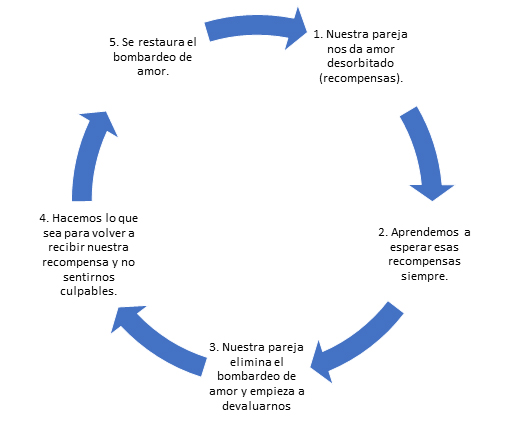
Phases love bombing

Doped with love, yes; love bombing, no.

Let’s take this opportunity to clarify the difference between love bombing and the euphoria we feel in the first stage of a relationship, which is influenced by a whole arsenal of hormones and neurotransmitters that cause us to act in a somewhat disproportionate way.

So, we ask ourselves, how do I distinguish between a phase of healthy infatuation and  love bombing?

Well, the reality is that it is not always easy to discern these behaviors. Mainly because Hollywood sells us that love bombing behaviors are normal and desirable in a relationship; so we could say that we expect it.

In healthy relationships, love comes in several phases, so the infatuation phase is not eternal. In the infatuation or “honeymoon” phase, we could say that we wear rose-colored glasses with which we tend to idealize the partner and only see the good in him or her. In this phase, we tend to go in unison with our partner, so we feel that we are the ones who set the speed at which we go.

However, in the case of love bombardment, it is not uncommon for the person to feel overwhelmed by the speed and intensity at which the love gestures occur.  It is normal to want to see or communicate with the person we are interested in; however, if these gestures become overwhelming, it may be an indicator that one is a victim of love bombing.

The main difference is the objective with which this overflowing manifestation of love is given (although it can be given unconsciously). This bombardment is given in order to change the actions of the other person and thus get him/her hooked on the relationship.

It is important to be attentive to possible red flags that we can see from the beginning of the relationship and not act under pressure from the other person.

Narcissistic profile: the expert bombers

Love bombing has a lot to do with narcissistic traits and low self-esteem.

The overflowing expression of love is all about validation. Validation that one is wanted, loved, valued, etc.

Did you know that love bombing was first seen in the 60’s in religious sects? Yes, in the end, the objective is no different than it is in a relationship: to seduce and make you never want to leave.

Before going into the narcissistic profile, it is worth clarifying that it is not the same to show narcissistic traits as to have a narcissistic personality disorder.

Some of the most characteristic features of a narcissistic profile are: lack of empathy, failure to take responsibility, defensive or victimizing attitude in the face of criticism, attention seeking and grandiose attitude. We can highlight mainly the need to feel important and/or special.

They are people who use others for their own benefit and even like to control others. However, it is not possible to do any of these things without manipulating the other; that is why they know how to sell themselves very well.

Thus, let’s see how a person with a narcissistic profile establishes a relationship:
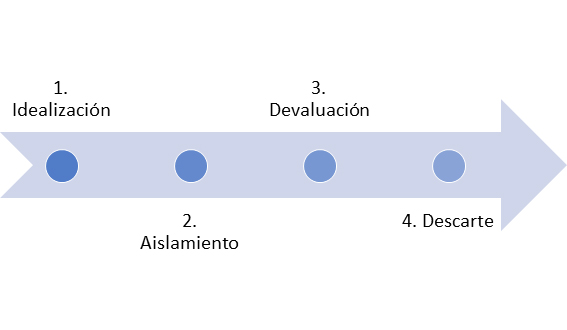
How a person with a narcissistic profile establishes a relationship

1. The narcissist starts the relationship precisely with love bombing, with the objective that his/her partner idealizes him/her.

To do this, he/she will try to make his/her partner feel that he/she is the most special and important person for him/her.

Some examples that may help to identify it:

  • Behavior completely disproportionate to the connection: for example, saying “I love you” after only a few days or hints of commitment.
  • Quick intimacy: acts such as introducing their family right away, wanting to meet your family, wanting to start living together, etc. It is common for the narcissistic person to tend to share a negative aspect of their past in order to victimize themselves and create empathy, causing their partner to do the same and thus, gain information they can use in the future.
  • Overwhelming compliments: almost as if they are trying to boost their partner’s self-esteem, they put them on a pedestal (and then treat them poorly). “You’re the best thing that’s ever happened to me,” “I’ve never met anyone as X as you,” “I can’t imagine a life without you”….
  • Too many gifts. At all hours and for no apparent reason. Details in every activity, meeting or even conversation.
  • Constant communication and attention: writing several times a day, making time to meet your partner, etc. Often, they are even “suffocating”.
  • Mirror technique: shows excessive affinity to everything your partner likes. Same tastes, same hobbies, same interests, same objectives.

2. Then he or she will begin to demand more attention. This will cause their partner, little by little, to increasingly limit his or her solitary activities (isolating).

3. It is then, when he/she has his/her partner already “trapped”, when the person with a narcissistic profile starts to show their true face and the problems begin. Every time he/she does not feel that he/she is the center of attention or that his/her needs are not given priority, he/she will start the string of manipulative behaviors: intermittent reinforcement (now I listen to you and now I don’t, for example), gaslighting, humiliation or triangulation (manipulation of the partner through the relationship with a third person), among others.

This phase is characterized by psychological and emotional violence with the aim of ridiculing, humiliating, ignoring, disqualifying, intimidating and blackmailing the partner.

Only when faced with the fear of losing their partner, if it occurs, the love bombing is reinstated.

4. In this type of relationship, the narcissist ends up abandoning his partner when he has another one secured. It is not uncommon that they commit infidelities and that after the breakup they show no regret or empathy for their now ex-partner.

This string of behaviors has the consequence of creating dependency in the partner, undermining their self-esteem, making them doubt their judgment and generating anxiety, depression and guilt among others.

Discerning a person who manipulates us is not always easy.

If you need help and you think you are or have been a victim of love bombing, ask for an appointment.

Júlia Tarancón Estades
Psychologist Col. No B-3232

Scroll to Top
Privacy Overview

Política de cookies:

Según la Ley 34/2002, de 11 de julio, de Servicios de la Sociedad de la Información y Comercio Electrónico le informamos de que este sitio web usa Cookies para mejorar y optimizar la experiencia del usuario. A continuación encontrará información detallada sobre qué son las “Cookies”, qué tipología utiliza este sitio web, cómo cambiar la configuración de sus cookies, y qué ocurre si las deshabilita.

¿Qué son las cookies?

Una cookie es un fichero que se descarga en su ordenador al acceder a determinadas páginas web. Las cookies permiten a una página web, entre otras cosas, almacenar y recuperar información sobre los hábitos de navegación de un usuario o de su equipo y, dependiendo de la información que contengan y de la forma en que utilice su equipo, pueden utilizarse para reconocer al usuario.

¿Qué tipos de cookies utiliza esta página web?

  • Según la entidad que las gestione, las cookies pueden ser:
  • Cookies propias: Son aquellas que se envían al equipo terminal del interesado desde un equipo o dominio gestionado por el propio editor y desde el que se presta el servicio solicitado por el usuario.
  • Cookies de terceros: Son aquellas que se envían al equipo terminal del usuario desde un equipo o dominio que no es gestionado por el editor, sino por otra entidad que trata los datos obtenidos través de las cookies.

El Sitio Web utiliza tanto cookies propias como de terceros.

  • Según el plazo de tiempo que permanecen activadas:
  • Cookies de sesión: Son un tipo de cookies diseñadas para recabar y almacenar datos mientras el usuario accede a una página web. Se suelen emplear para almacenar información que solo interesa conservar para la prestación del servicio solicitado por el usuario en una sola ocasión (p.ej. una lista de productos adquiridos).
  • Cookies persistentes: Son un tipo de cookies en el que los datos siguen almacenados en el terminal y pueden ser accedidos y tratados durante un periodo definido por el responsable de la cookie, y que puede ir de unos minutos a varios años.

El Sitio Web utiliza tanto cookies persistentes como cookies de sesión.

  • ¿Para qué finalidades pueden ser utilizadas las cookies de la web?
  • Cookies técnicas: Son aquéllas que permiten al usuario la navegación a través de una página web, plataforma o aplicación y la utilización de las diferentes opciones o servicios que en ella existan como, por ejemplo, controlar el tráfico y la comunicación de datos, identificar la sesión, acceder a partes de acceso restringido, recordar los elementos que integran un pedido, realizar el proceso de compra de un pedido, realizar la solicitud de inscripción o participación en un evento, utilizar elementos de seguridad durante la navegación, almacenar contenidos para la difusión de videos o sonido o compartir contenidos a través de redes sociales.
  • Cookies de personalización: Son aquéllas que permiten al usuario acceder al servicio con algunas características de carácter general predefinidas en función de una serie de criterios en el terminal del usuario como por ejemplo serian el idioma, el tipo de navegador a través del cual accede al servicio, la configuración regional desde donde accede al servicio, etc.
  • Cookies de análisis: Son aquéllas que permiten al responsable de las mismas, el seguimiento y análisis del comportamiento de los usuarios de los sitios web a los que están vinculadas. La información recogida mediante este tipo de cookies se utiliza en la medición de la actividad de los sitios web, aplicación o plataforma y para la elaboración de perfiles de navegación de los usuarios de dichos sitios, aplicaciones y plataformas, con el fin de introducir mejoras en función del análisis de los datos de uso que hacen los usuarios del servicio.
  • Cookies publicitarias: Son aquéllas que permiten la gestión, de la forma más eficaz posible, de los espacios publicitarios que, en su caso, el editor haya incluido en una página web, aplicación o plataforma desde la que presta el servicio solicitado en base a criterios como el contenido editado o la frecuencia en la que se muestran los anuncios.
  • Cookies de publicidad comportamental: Son aquéllas que permiten la gestión, de la forma más eficaz posible, de los espacios publicitarios que, en su caso, el editor haya incluido en una página web, aplicación o plataforma desde la que presta el servicio solicitado. Estas cookies almacenan información del comportamiento de los usuarios obtenida a través de la observación continuada de sus hábitos de navegación, lo que permite desarrollar un perfil específico para mostrar publicidad en función del mismo.

Cookies propias

Nombre Dominio Duración
ANnoElGaWR_ psicologiasexologiamallorca.com al día
ZeDOrRxVc psicologiasexologiamallorca.com al día
OPQjcGKa_TCntuSv psicologiasexologiamallorca.com al día
dQ_tKeuinJgZhFWM psicologiasexologiamallorca.com al día
joinchat_views psicologiasexologiamallorca.com al día

Cookies de Terceros

Nombre Descripción Proveedor información
Google Analytics Cookies de Google Analytics. Generan un ID de usuario anónimo, que es el que se utiliza para hacer recuento de cuantas veces visita el sitio un usuario. También registra cuando fue la primera y la última vez que visitó la web. Asimismo, calcula cuando se ha terminado una sesión, origen del usuario, y keywords. Google Ver

¿Qué ocurre si se deshabilitan las Cookies?

Algunas funcionalidades de los Servicios y áreas de este sitio web podrían no funcionar correctamente si se deshabilitan las cookies.

¿Actualizamos nuestra Política de Cookies?

Es posible que actualicemos la Política de Cookies de nuestra página web, por ello le recomendamos revisar esta política cada vez que acceda a nuestro sitio web con el objetivo de estar adecuadamente informado sobre cómo y para qué usamos las cookies.

¿Cómo puede configurar y/o rechazar sus Cookies?

Al clickar en “ENTENDIDO” y continuar en nuestro sitio web, estará consintiendo el uso de las Cookies en las condiciones contenidas en la presente Política de Cookies. Usted como usuario tiene la posibilidad de ejercer su derecho a bloquear, eliminar y rechazar el uso de Cookies, en todo momento, modificando las opciones de su navegador. Por ejemplo:

  • Microsoft Edge: Configuración> Configuración Avanzada> Cookies.

Consulta el soporte de Microsoft o la Ayuda del navegador.

  • Mozilla Firefox: Herramientas> Opciones> Privacidad> Historial> Configuración Personalizada.

Consulta el soporte de Mozilla o la Ayuda del navegador.

  • Google Chrome: Configuración> Mostrar opciones avanzadas > Privacidad> Configuración de contenido.

Consulta el soporte de Google o la Ayuda del navegador.

  • Safari (Apple): Preferencias> Seguridad.

Consulta el soporte de Apple o la Ayuda del navegador.

  • Opera (Opera Software): Configuración > Opciones > Avanzado > Cookies

Consulta el soporte de Opera o la Ayuda del navegador.

Si usa otro navegador, consulte su política de instalación, uso y bloqueo de cookies. No obstante, usando la herramienta www.youronlinechoices.com, podrá encontrar información útil y configurar, proveedor por proveedor, sus preferencias sobre las cookies.

¿Sólo existen cookies?

Puede ser que haya webs que usen otras formas de almacenamiento similar a las cookies pero con más capacidad, como otras formas de almacenamiento local de datos en el equipo del cliente, por ejemplo:

  • LocalStorage y sessionStorage de HTML5: Espacio que la web puede usar en el equipo del usuario. Normalmente borrando el historial de Navegación se pueden borrar.
  • Los «Local Shared Objects» de Flash (el «isolated storage» de Silverlight): Se almacenan dentro de la carpeta de Microsoft de donde tiene el perfil de usuario. Hay que entrar en la carpeta y borrarlo. (Ejemplo: los videos de vimeo).
    Flash sirve para incorporar elementos multimedia en una web, y para ello almacena ficheros en el equipo del usuario.
  • El web beacon sirve para rastrear tu actividad, insertando una mini-imagen de la que ni siquiera te percates. Cuando navegas por la web, se te carga junto con la página, y el servidor de dónde se descarga la foto, registra la hora del acceso, o las veces que has accedido.

Estos archivos son más intrusivos que las cookies, ya que son más complicados de eliminar, guardan más información, y son independientes al navegador que se use. Nosotros no usamos este tipo de almacenamiento.